

Land & Timber · Tested — I own this one. Estimates are labeled as estimates.
How long does it take pine trees to grow into something a logger will pay for? Longer than the brochure says, shorter than your patience thinks. I can tell you because I’ve been watching the same rows of loblolly since 2010.
Here’s the thing nobody tells you about planting pines: for about ten years, nothing happens. You drive out, you look at the trees, the trees look slightly taller than last time, you drive home. There is no quarterly report. There is no dashboard. There’s a gate, a gravel road and a lot of green that doesn’t care about your timeline.
Then one year a crew shows up with a cutter and a loader, and you find out what all that waiting was worth.
This is the year-by-year version, from planting day to where my stand sits now at sixteen growing seasons. Real dates from my own land, sourced numbers for everything else.
The Short Answer: How Long It Takes Pine Trees to Grow
For a planted loblolly stand in Arkansas, the rough timeline looks like this:
- Years 1–3: keep the seedlings free of competition. This is where stands are won or lost.
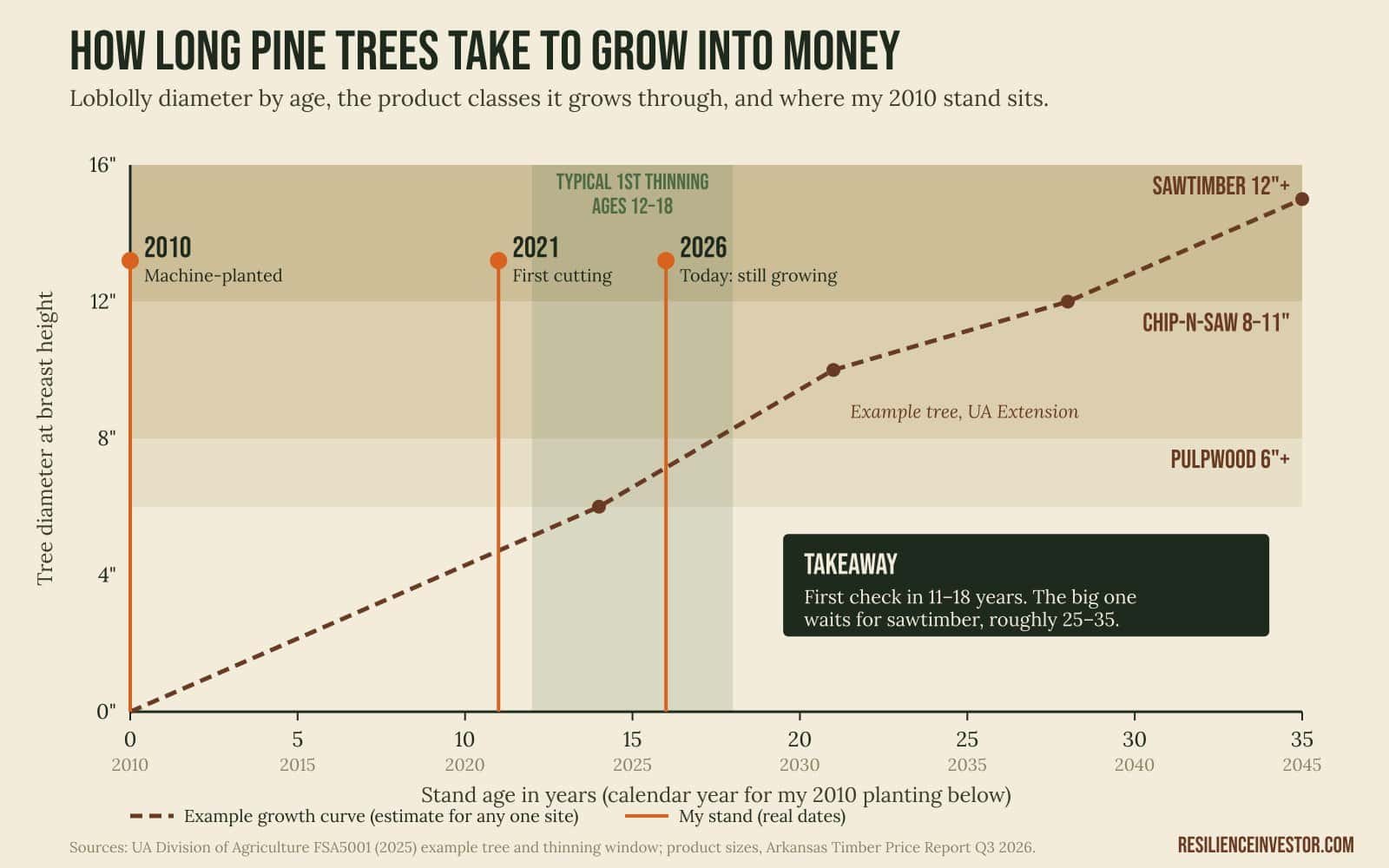
- Years 12–18: first commercial thinning, when trees reach pulpwood size, about 6 to 9 inches across. That window comes from the University of Arkansas Division of Agriculture’s thinning guide.
- Every 5–6 years after that: another thinning, whenever the crowns start touching again.
- Roughly 25–35 years: final harvest, once enough of the stand is sawtimber.
My stand is running a little ahead of that: planted 2010, first cutting in 2021, still growing today. So the honest answer to how long pine trees take to grow is about 11 to 18 years to the first check and 25 to 35 years to the big one, depending on your soil, your spacing and how well you kept the brush off early.
What “Grown for Timber” Actually Means
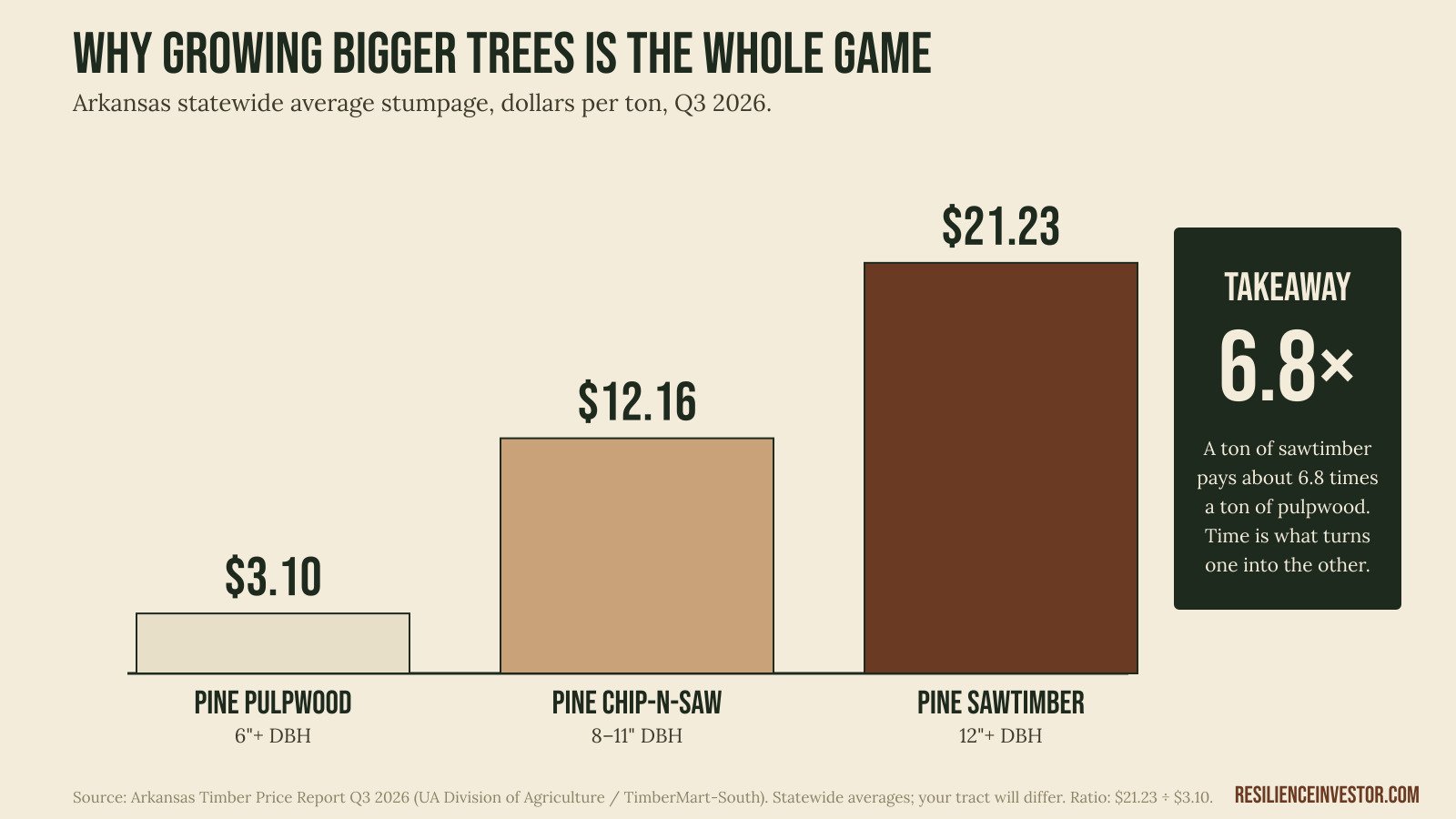
A pine tree isn’t “ready” at one moment. It graduates through product classes, and each class pays a very different price. Arkansas sorts standing pine by its diameter at breast height, measured about four and a half feet off the ground:
| Product | Size (DBH) | Arkansas stumpage, Q3 2026 | What it becomes |
|---|---|---|---|
| Pine pulpwood | 6″+ | $3.10 per ton | Paper, packaging, pellets |
| Pine chip-n-saw | 8″–11″ | $12.16 per ton | Small lumber, plus chips |
| Pine sawtimber | 12″+ | $21.23 per ton | Lumber, poles, plywood |
Prices are statewide averages from the Arkansas Timber Price Report, Q3 2026, checked November 2026. Your tract will differ.
Read that table again. A ton of sawtimber is worth almost seven times a ton of pulpwood. That’s the whole game. Growing pines for timber is really about how many of your trees you can walk up that ladder before you cut them.
The Pine Growing Timeline, Year by Year
Here’s how my stand actually went, laid against what the extension foresters say should happen. Five stages:
- Plant it right (year 0)
- Keep it free to grow (years 1–3)
- Wait, and build your roads (years 4–10)
- Take the first cut (years 11–18)
- Grow the money trees (year 12 to final harvest)
The step that saves you the most money is number 2, and the step I’d redo is number 3. More on both below.
Year 0 (2010): Plant It Right
We machine-planted loblolly in 2010, about three years after I bought the land. Loblolly is the default pine for this part of the country for a reason: it grows fast and the mills know what to do with it.
Machine planting means a tractor pulls a planting bar that opens a slit, drops a seedling and closes it behind, row after row. It’s quick and the rows come out straight, which matters more than you’d think fifteen years later when a logging crew needs to drive down them.
For a sense of cost today, a 2024 survey of southern forestry contractors found machine planting averaged about $190 an acre at roughly 614 seedlings per acre, according to the Alabama Cooperative Extension System’s cost report. That’s 2024 money, not what we paid in 2010.
One thing has shifted since then. Because pulpwood is worth so little now, Arkansas foresters are steering landowners toward lower planting densities, around 300 to 450 trees per acre, so trees reach bigger sizes sooner. If I were planting today, I’d have that conversation with a forester before the seedlings got ordered.
Years 1–3: Keep It Free to Grow
We sprayed and treated the stand early. If there’s one step in this whole timeline I’d tell a new landowner not to skip, it’s this one.
Young pines can’t stand shade. If sweetgum, oak sprouts and briars get above them in the first few years, the pines don’t die. They just sit there, stunted, wasting years you’ll never get back. That’s why foresters do a release treatment: a herbicide aimed at everything except the pines, usually when the seedlings are one to three years old, per LSU AgCenter’s guide to pine release.
It costs money in a year when the land pays you nothing. It’s still the best money you’ll spend on the stand.
Years 4–10: Wait, and Build Your Roads
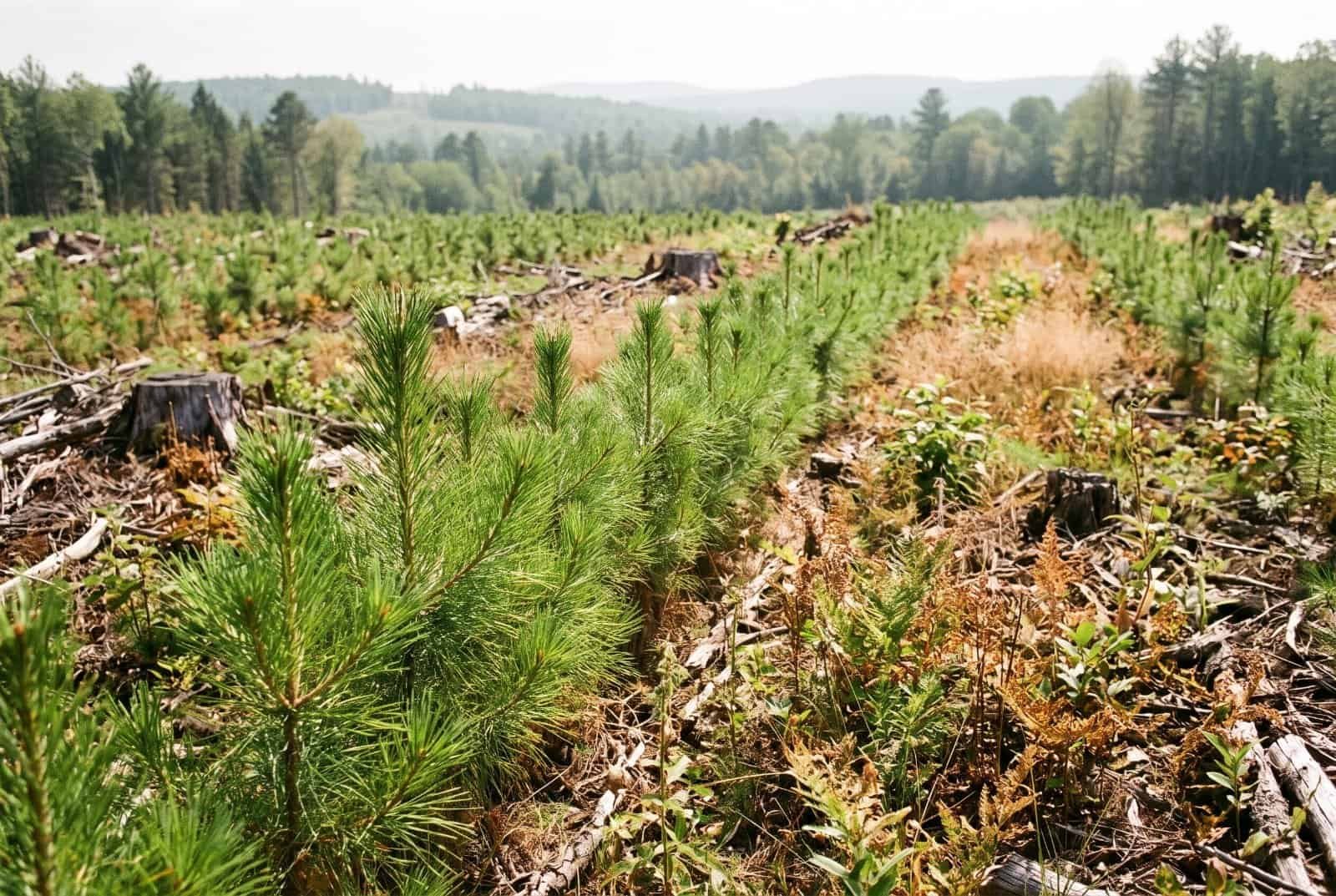
This is the boring decade. The pines close canopy, the lower limbs start dying off, and the stand starts to look like a forest instead of a field.
It’s also when you should be doing the work that pays off later: roads.
We built roads and a small bridge on the property. If I did it over, I’d build better access roads around the whole tract, and I’d do it in these quiet years, before anybody needs them. More on that under the lessons below.
Year 11 (2021): Take the First Cut
Our first cutting came in 2021, eleven growing seasons after planting. That’s the early edge of the 12-to-18-year window the University of Arkansas guide gives for a first commercial thinning, which is what you’d expect from a stand that got sprayed early and kept growing.
A first thinning is not a payday, and it’s not supposed to be. It mostly removes pulpwood: every few rows come out to give the harvesting equipment room, and then the crowded, crooked, forked and suppressed trees between those rows go too. What stays are the straight, dominant trees. The extension guide calls them the “money trees,” and that’s a fair description.
For the selling side of that cut, how to get bids and what goes in the contract, I wrote up how to sell timber without getting ripped off.
Year 12 to Final Harvest: Grow the Money Trees
That’s where my stand sits now. Sixteen growing seasons in, the trees are growing and getting bigger, which is exactly what thinning is for. Same acre, fewer trees, more sunlight and water per tree.
From here, the guide says to thin again before the live crowns drop below about 30 percent of the tree’s height, or when the crowns start touching again, generally every five or six years. On that schedule, my next look is due now, and a second thinning in the next few years would be normal (estimate, pending a forester’s walk-through).
How long until the big harvest? Here’s the guide’s example tree on a decent site:
| Tree age | Diameter | Height | Product |
|---|---|---|---|
| 14 years | 6″ | 41 ft | Pulpwood |
| 21 years | 10″ | 54 ft | Chip-n-saw |
| 28 years | 12″ | 64 ft | Sawtimber |
| 35 years | 15″ | 72 ft | Sawtimber |
Example tree from the University of Arkansas thinning guide (FSA5001, 2025). Your site and spacing change all of it.
The U.S. Forest Service’s “Sudden Sawlog” study near Crossett, Arkansas, set out to prove loblolly could grow sawtimber in 30 years with intensive management on good ground, and it did. So for my stand, final harvest probably lands somewhere between the late 2030s and the 2040s (estimate). The trees will tell me. So will the market.
Key Considerations Before You Grow Pine Timber
The pulpwood market is not your friend right now. Arkansas pine pulpwood stumpage hit $3.10 a ton in Q3 2026, down about 20 percent from a year earlier. The Arkansas Center for Forest Business reported that inflation-adjusted pine pulpwood prices hit their lowest level in roughly 25 years. If your plan depends on early thinnings paying well, re-run that plan.
Arkansas pays less than the rest of the South. In that same Q3 2026 report, Arkansas pine sawtimber averaged $21.23 a ton against $23.88 South-wide. Where your land sits relative to mills matters as much as what’s growing on it.
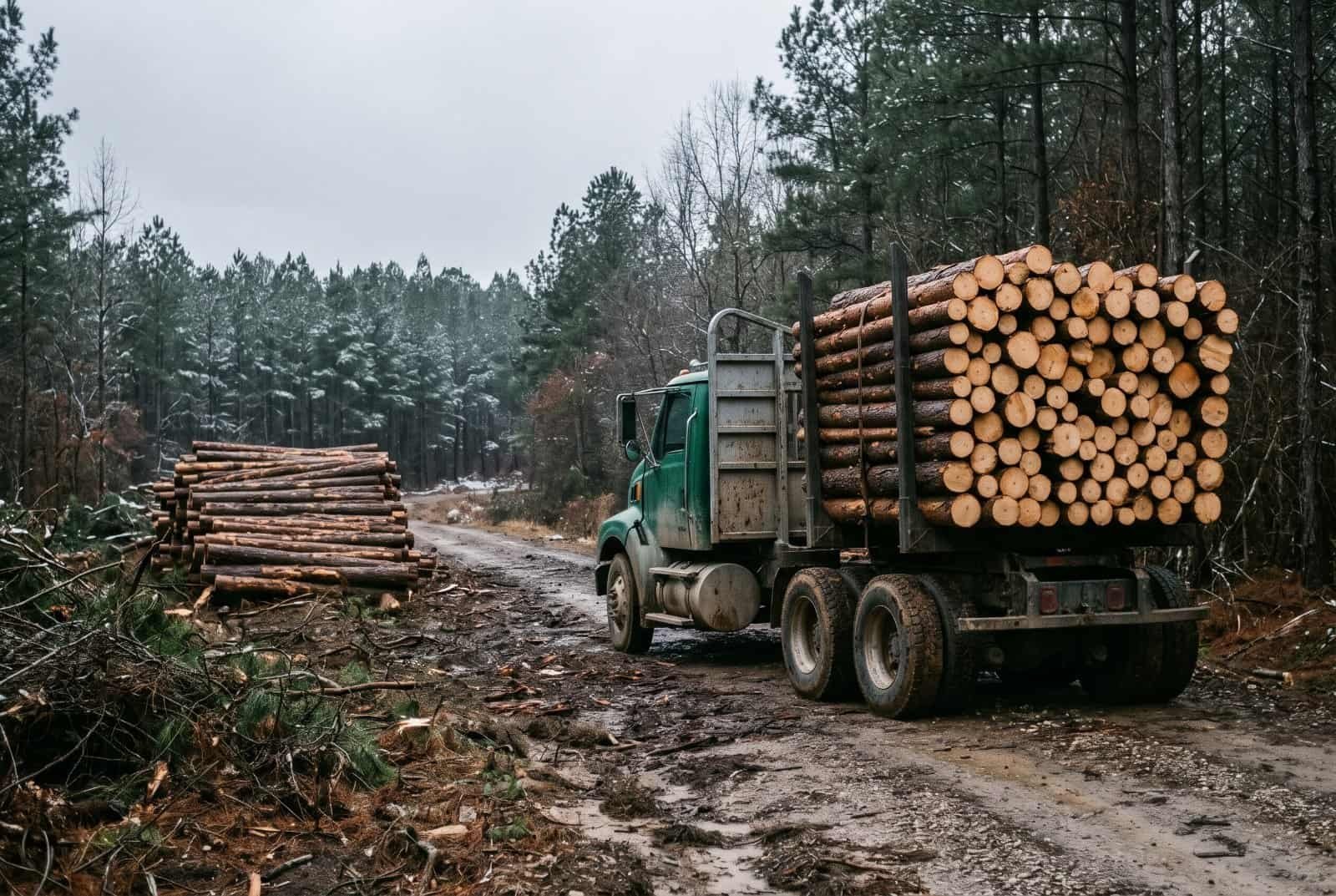
Hauling costs come out of your check. The Q3 report notes Gulf Coast diesel near $6 a gallon and a widening gap between what mills pay for delivered logs and what landowners get on the stump. Every mile and every bad road between your trees and the highway is money the logger has to cover somehow, and usually it’s covered out of your bid.
Patience is the actual investment. Sixteen years in, my stand has paid exactly one check. That’s normal. If you’re weighing timber against other long-horizon money moves, it’s the same compounding math as starting late on retirement savings: the early years look like nothing, and the back half does the heavy lifting.
Taking It to the Next Level: What I’d Do Differently
Build better access roads, all the way around the property, early.
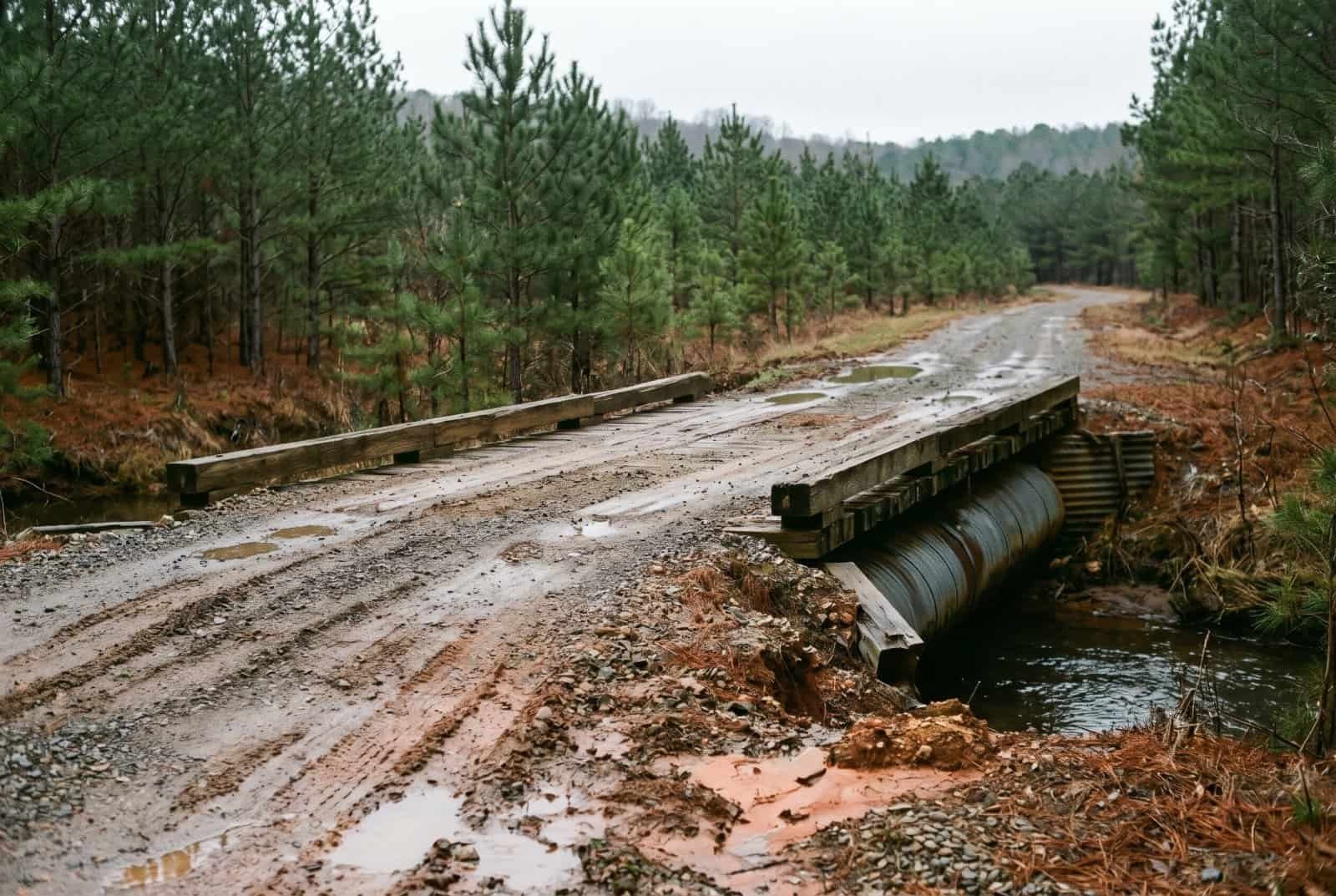
Roads are the unglamorous part of owning timber, which is exactly why people underbuild them. But when a thinning crew comes in, the condition of your roads decides how fast they can work, how much ground they tear up getting to the trees, and how much of their cost ends up deducted from your bid. Good roads also make the land easier to walk, hunt, check and eventually sell.
If you’re shopping for land you might plant someday, put road access on your due-diligence list. It’s on my checklist for buying rural land for this exact reason.
Alternatives to Planting Pines Yourself
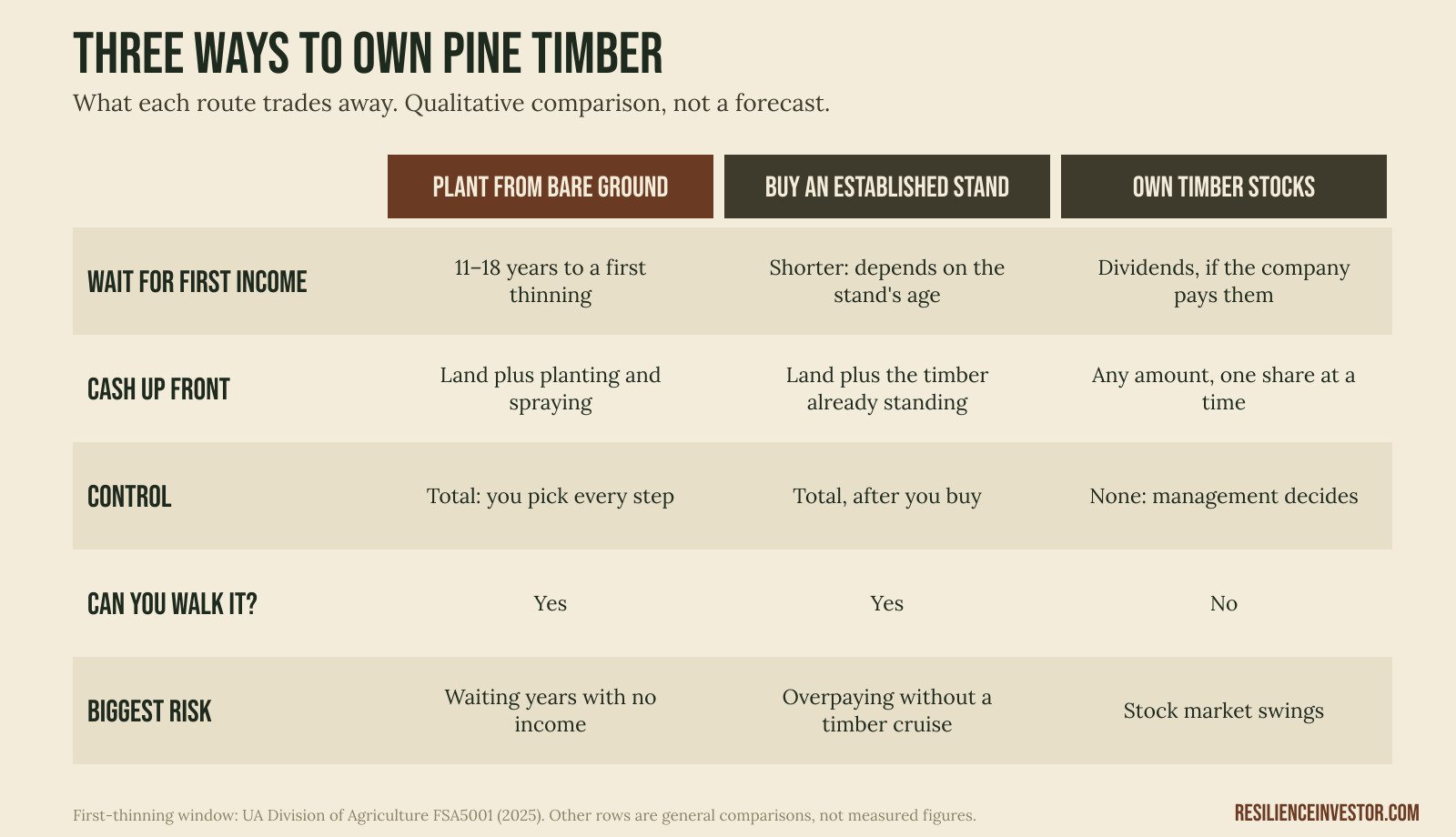
Not everybody needs to start from bare ground:
- Buy land with an established stand. You pay more up front, but you skip the decade of nothing. Get a timber cruise before you buy so you know what’s standing.
- Lease the land while the trees grow. A hunting lease won’t make you rich, but it pays something every year while the pines do their thing. I covered what mine looks like in the full math on my 40 acres.
- Don’t own land at all. If what you want is timber exposure without the gate and the gravel, publicly traded timber companies exist. Just know you’re buying a stock, not trees you can walk through. If speed of getting your money out matters, here’s how fast land actually sells compared with other hard assets.
Frequently Asked Questions About How Long Pine Trees Take to Grow
How long does it take pine trees to grow big enough to sell? A planted loblolly stand usually reaches its first commercial thinning at 12 to 18 years, when trees hit pulpwood size. Mine came at 11. Sawtimber, the high-value product, generally takes 25 to 35 years.
How fast do loblolly pines grow per year? On a decent site, a young loblolly can put on a couple of feet of height a year. In the University of Arkansas example, a tree goes from 41 feet at age 14 to 64 feet at age 28. Diameter growth matters more for value than height does.
What is the best age to harvest pine trees? For a final harvest, most planted stands are cut between about 25 and 35 years, once enough trees are sawtimber. The right answer depends on prices when you’re ready, so get a forester’s cruise before you sell.
Is planting pine trees a good investment? It can be, if you can wait decades, keep competition down early and sell into a decent sawtimber market. It’s a poor fit if you need income in the first ten years, because there isn’t any.
Do you have to thin pine trees? You don’t have to, but unthinned stands grow lots of small trees instead of fewer big ones, and small trees mostly sell as low-value pulpwood. Thinning moves growth onto the trees worth the most.
How much does it cost to plant pine trees per acre? A 2024 survey of southern forestry contractors put machine planting at about $190 an acre, seedlings included, with site preparation and herbicide extra. Your county Extension office or a consulting forester can give you local numbers.
Wrapping Up: My Experience Watching Pine Trees Grow
So how long does it take pine trees to grow? On my 40 acres, eleven years to the first cut, sixteen years to “getting bigger and worth more,” and probably another decade or two to the harvest that makes the whole thing worth it.
If you own pines, do this this month: walk the stand and look up. If the crowns are touching, call a consulting forester or your county Extension office and ask whether it’s time to thin. And if you’re new here, start with the basics.
Every post on Resilience Investor is labeled for what it is: Tested means I own it, Researched means I don’t yet and I’ll say so, Verified means the math checks against a real source. More in the Land & Timber archive.
Free Rural Land Checklist
The 3-page printable I'd want before buying land: access, survey, minerals, flood, soils, title and money. Plus new land, timber and metals math in your inbox. Unsubscribe anytime.