
Does Money Grow on Trees? I Own 40 Acres of Them. Here’s the Math.
At-a-Glance Summary:
- The Core Thesis: While traditional financial wisdom claims money doesn’t grow on trees, owning real physical land and tangible timber provides a tangible, inflation-hedged compounding asset outside of Wall Street.
- The Asset: 40 acres of loblolly pine in Arkansas, bought through a standard loan and paid off over five years.
- The Takeaway: Timber growth acts as a natural dividend reinvestment plan fueled by photosynthesis rather than quarterly earnings reports or market sentiment.
Everybody’s grandpa said it. “Money doesn’t grow on trees.” Delivered with the same flat certainty as “the stove is hot” and “no, we’re not getting a dog.” A load-bearing piece of American folk wisdom, passed down for generations, treated as settled fact.
Grandpa was wrong. Mine just didn’t own any trees.
I do. Forty acres of loblolly pine in Arkansas, to be specific. And it turns out that when you actually own trees — not a timber ETF, not a REIT, an actual stand of actual pine — the cliché falls apart a little. Money doesn’t grow on trees in the sense of dollar bills sprouting from branches like some kind of arboreal ATM. But value does. Measurably. Annually. Without a Fed meeting, an earnings call, or a guy on financial television explaining why this time is different.
Let’s do the math nobody asked for.
What I Actually Own
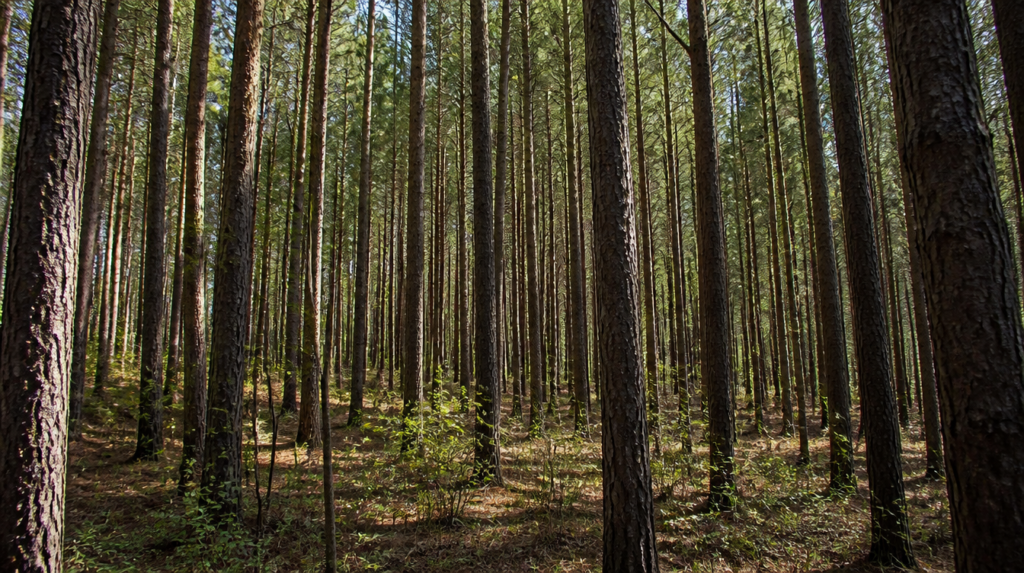
Forty acres, bought on a five-year loan, paid off years ago. Not inherited. Not a family plot handed down with a deed and a guilt trip attached — purchased, financed, and paid for the boring way, one payment at a time, same as a truck or a mortgage. I mention this because “generational land” and “land I bought with discipline and a loan officer who probably rolled his eyes” are very different stories, and this site only tells the second kind.
The trees are loblolly pine, which — fun fact I did not go looking for but now cannot stop thinking about — gets its name from 18th-century English slang for a mudhole, or a thick, unglamorous stew. Early Southern settlers looked at this tree, thought “that’s a mudhole tree if I’ve ever seen one,” and the name stuck for three centuries. Nothing about loblolly pine has ever tried to impress anyone. It just grows. Reliably. In the mud. Which, if you squint, is a better investment thesis than half the things currently trending on financial Twitter.
If you are looking to understand more about managing physical rural assets and the realities of land acquisition, you can check out insights on land management over at Adventure Wiser.
I haven’t done the first thinning yet — that’s a couple years out. The trees are still doing what trees do: getting taller, getting wider, quietly compounding board-feet the same way a dividend reinvestment plan compounds shares, except nobody’s issuing a press release about it. To understand how systemic biological growth compares to traditional equities, resources like the USDA Forest Service Timber Market Statistics offer deep dives into how physical timber markets behave over multi-decade horizons.
The Part Where the Math Actually Shows Up
Here’s the comparison nobody selling you a brokerage app wants to make out loud: a share of stock is a claim. A very well-regulated, historically profitable, perfectly legitimate claim — but a claim nonetheless. It represents a promise that a company will keep performing, that the market will keep believing the story, and that the number on your screen still means something the next time you check it.
A stand of pine doesn’t require belief. It doesn’t have a quarterly call where management explains “headwinds.” Nobody’s going to downgrade my timberland because sentiment shifted. The trees do not care about sentiment. The trees are busy converting sunlight into lumber, which is a slower and considerably less exciting process than watching a ticker, but it is one that has worked, without interruption, for the entire history of forestry as a concept.
This is fine — genuinely, this time. Timber grows on photosynthesis, and photosynthesis hasn’t had a bad quarter in about four billion years. That’s a track record even the most aggressive fund manager would have a hard time matching, and it comes with zero expense ratio. For a broader academic and economic perspective on why tangible hard assets and commodities have historically served as reliable inflation anchors, take a look at research from the National Council of Real Estate Investment Fiduciaries (NCREIF) regarding timberland index performance.
None of this means land beats stocks, categorically, always, in every scenario — I’m not telling you to sell your index fund and go buy a mudhole tree farm. I’m telling you that “money doesn’t grow on trees” was never really about trees. It was shorthand for “value doesn’t just appear,” and somewhere along the way, an entire industry decided the best way to make value appear was a chart that only goes up until it very much doesn’t.
Why This Is the First Post
I own the land. I made the payments. I’ll do the thinning when it’s time, and I’ll tell you exactly what that costs, because a number I made up would be worthless and a number I paid would not be.
That’s the whole model here: Tested when I’ve done it myself, Researched when I haven’t, Verified either way. This one’s Tested. Forty acres, one loan, no shortcuts, no inheritance, no story more interesting than “I bought a thing and it’s slowly becoming worth more because that’s what pine trees do.”
Your 401(k) can’t grow trees. Mine already has.